
AI visibility trackerfind out why AI skips you, and fix it
Rankfender’s AI visibility tracker asks ChatGPT, Claude, Gemini, Perplexity, DeepSeek, Grok, Llama and Mistral the questions your buyers ask and shows whether you are named. Then it shows who is named instead and which sites the assistants rely on, checks that AI can read your site, and turns each gap into content, fixes and a plan.
Starts on Essential: $89 a month. Questions tracked: 15 on Essential, 30 on Professional, 80 on Business, unlimited on Agencies.
What you get from Rankfender AI visibility
When you look for an AI visibility tracker, you first want to know whether ChatGPT and other AI assistants recommend you. Then you want to know why they don’t, and what to do about it. Rankfender answers all of them:
- Do AI assistants name my brand when buyers ask about my market?
- Who do they name instead, and which sites do they rely on?
- Why am I not named: my content, my sources, or a site AI can’t read?
- What should I publish or fix, and is it working?
- 01
Your AI visibility, assistant by assistant
You get the share of answers that name you on questions without your name, your position and the tone, from ChatGPT, Claude, Gemini, Perplexity, DeepSeek, Grok, Llama and Mistral, followed check after check.
- 02
Who AI names instead, and why
You get every brand the assistants name, ranked by share of voice, the questions you lose, the sites they cite and your visibility per topic, buyer profile and buying stage.
- 03
Whether AI can read your site
You get the GEO checks of the site audit: which AI crawlers your robots.txt lets in, your llms.txt, your structured data and how easy your pages are for AI to quote.
- 04
Content that closes the gaps
You get content ideas built from the answers (Professional and up), and articles from the AI content writer, published to WordPress with their structured data.
- 05
The fixes, written for you
You get an llms.txt file, FAQ schema and briefs from RAISA, and on Business a 90-day strategy that turns lost questions and cited sites into moves with the fix ready.
- 06
Proof that it works
You get a trend for every assistant, the AI Visibility report as a PDF or by email, and on Professional and up the visits AI assistants send to your site, from Google Analytics.
Track, diagnose, act, prove
Tracking is the first step. Each of the four steps below has its own place in Rankfender.
Track
- Your buyer questions, asked to 8 AI assistants
- Mention rate, position and tone
- Competitor share of voice
Diagnose
- The questions you lose, and to whom
- The sites AI cites instead of you
- AI crawler access, llms.txt and schema on your site
Act
- Content ideas and articles for each gap
- llms.txt, FAQ schema and briefs from RAISA
- A 90-day strategy with the fix for each move (Business)
Prove
- A trend per assistant, check after check
- Visits from AI assistants (Professional and up)
- AI Visibility reports, by PDF or email
What the AI visibility tracker measures
Every answer is read and scored. These are the numbers you follow from one check to the next.
Mention rate
The share of answers that name your brand. We match your full brand name, your domain and the other names you add, never single words.
Position in the answer
Whether you are named first, in the middle or last. Buyers read the first names first.
Sentiment
Positive, neutral or negative, with the actual sentences each assistant wrote about you.
Sources named
The sites the assistants cite in their answers, and whether your own site is one of them.
Competitor share of voice
Each competitor’s share of all brand mentions, next to yours.
Questions with and without your name
Most questions don’t contain your name. A “Names you” filter keeps the ones that do apart.
Who AI visibility tracking is for
Business owners
Find out in plain words whether AI assistants recommend you or a competitor when buyers ask about your market, and what to do about it.
Marketers and SEO teams
Add AI answers to your reporting: visibility per assistant, topic and buying stage, a weekly trend, and content ideas your writers can start from.
Agencies
Track each client brand with its own questions and competitors, and show progress with the AI Visibility report. Business covers 5 brands, Agencies unlimited.
E-commerce and SaaS brands
See which brands AI names for “best” and “alternatives to” questions in your category, and which review sites, directories and forums it cites.
How the AI visibility tracker works
Nothing to install. Add your site, and the first answers come in with your first AI check.
Add your site and brand names
Create a project with your domain. Add the other names your brand goes by, so answers that use them are counted.
Get your buyer questions
Rankfender suggests questions from your topics and buyer types, mostly without your name. Add your own, paste a list or turn keywords into questions.
Run the first AI check
Each assistant is asked every active question. You can leave the page: the results appear when the check is done.
Read the Summary
See your AI visibility, who is named instead, where AI gets its answers and what it says about you, by assistant, topic, buyer profile and buying stage.
Act, then let checks repeat
Turn gaps into content ideas, articles and fixes. Checks repeat weekly, or more often on Professional and up, so you see whether your work moves the number.
Which AI assistants we check, and how
Each assistant is asked through its official API, under the same conditions every time. Perplexity answers with live web sources; the others answer from the model itself, without web browsing.
| Assistant | Company and model family | How we ask |
|---|---|---|
| ChatGPT | OpenAI, GPT models | Official OpenAI API, no web browsing |
| Claude | Anthropic, Claude models | Official Anthropic API, no web browsing |
| Gemini | Google, Gemini models | Official Google API, no web browsing |
| Perplexity | Perplexity, Sonar models | Official Perplexity API, answers with live web sources |
| DeepSeek | DeepSeek, DeepSeek models | Official DeepSeek API, no web browsing |
| Grok | xAI, Grok models | Official xAI API, no web browsing |
| Mistral | Mistral AI, Mistral Large | Official Mistral API, no web browsing |
| Llama | Meta, open Llama model | Hosted API, no web browsing |
Apart from Perplexity, answers come from the model itself, not from a live web search. That keeps checks comparable over time. It also means your results can differ from what one signed-in user sees.
Where your questions come from
Rankfender writes questions from your topics and buyer types, the way a buyer would ask an assistant. You can also add your own, paste a list or turn your keywords into questions, and edit or pause any of them.
- 15 questions on Essential, 30 on Professional, 80 on Business, unlimited on Agencies
- Grouped by topic, buyer type and buying stage
- Mostly questions without your name: they show whether AI recommends you on its own
- Each question is flagged “Names you” or not; you can change the flag, and named questions stay out of the score
- Paused questions are skipped by scheduled checks until you resume them
Your AI visibility score, and how we measure it
The headline figure is simple: in how many answers to questions that don’t contain your name are you named? Questions that name you are kept out, because AI almost always names you there.
A percentage appears from 10 answers on; before that, you see the count. The weekly trend starts once checks have run in 3 different weeks.
- Counted on questions without your name, so it measures recommendations, not recall
- Shown next to a typical figure for the brands we track
- Broken down by assistant, topic, buyer profile and buying stage
- Followed over time, check after check, for all assistants or one at a time
- Each assistant shows a status, so you see if one has stopped answering
Which competitors AI names instead
The Competitors tab ranks every brand the assistants name: mentions, questions, cited URLs and share of voice. Add the competitors you want to follow; brands that appear in answers are listed too. You also see your rank among the brands you track and your average mention order.
Where AI gets its answers, and what it says about you
Assistants build their answers from sources. The Summary lists the sites they cite when they answer your buyers, how many answers cite sources and how often your own site is one of them. Sites that are not competitors, such as forums, directories, videos and review sites, are places to get listed or mentioned.
When an assistant names you, you see whether the answer is positive, neutral or negative, with the actual sentences it wrote. The Answers tab shows every full answer, question by question.
Find out why AI doesn’t name you
An assistant names the brands it finds in the sources it trusts and on the pages it can read. Rankfender shows you both sides, so you know whether the problem is your content, your presence on other sites or your own site.
- The questions you lose: AI names a competitor and not you
- The sites AI cites when it names a competitor: forums, review sites, directories, media
- Your visibility per topic, buyer profile and buying stage: where buyers never hear of you
- The site audit’s GEO checks: AI crawlers allowed or blocked in robots.txt, llms.txt, structured data and pages AI can quote
- What AI says about you, with the actual sentences, when the tone is negative
Fix it: AI visibility optimization, from gap to published page
Content ideas turns the answers into work: where competitors are cited and you are not, which platforms AI quotes, and what to publish so you are named more often. Each idea lists its target keywords and the source behind it. Add any idea to Planning in one click.
The AI content writer turns a lost question into an article and publishes it to WordPress with its structured data. RAISA, the AI SEO agent, writes your llms.txt file and FAQ schema to paste, and turns a gap into a brief in Planning. In the Answers tab, any page an assistant cites can become a content idea.
Plan it: AI answers inside your 90-day strategy
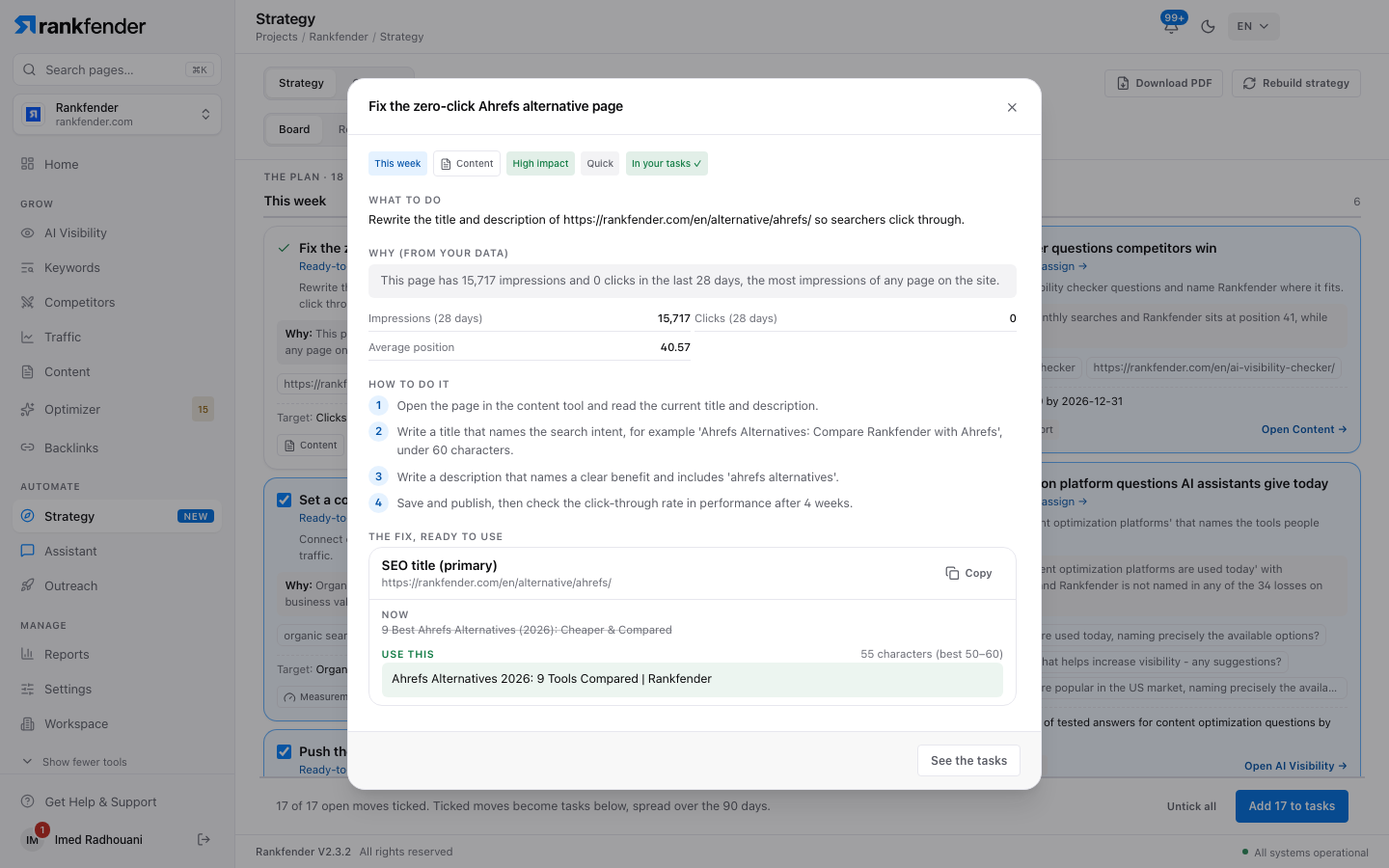
On Business and Agencies, Strategy reads your AI answers next to your keywords, competitors, traffic and site health. The questions you lose and the sites cited for your competitors become moves, each with the fix written: the page to publish, the FAQ and its schema, or the email asking for a mention.
Prove it: AI traffic and reports
Every check adds a point to your trend, for all assistants or one at a time, so you see whether your work moves the number. Send the AI Visibility report as a PDF, or schedule it by email.
Connect Google Analytics (Professional and up) and Traffic › AI traffic shows the visits AI assistants send you: per assistant, over time, and the pages people land on.
How it differs from checking AI answers by hand
Many teams start by typing a few questions into ChatGPT, or by adding a tracking tool. Here is what changes with Rankfender.
| Checking by hand | Tracking tool | Rankfender AI visibility | |
|---|---|---|---|
| Assistants | One or two, one at a time | Several, on a schedule | ChatGPT, Claude, Gemini, Perplexity, DeepSeek, Grok, Llama and Mistral in one check |
| Conditions | Your own account, history and settings | Neutral conditions | The same neutral conditions every time |
| Questions | A handful, often with your brand name in them | A list you write | Your buyer questions, mostly without your name, grouped by topic and buying stage |
| Competitors | Noted by hand | Share of voice | Every brand named, ranked by share of voice, and the questions you lose |
| Why you are not named | Guesswork | The sources cited | The sources cited, plus AI crawler access, llms.txt and schema on your site |
| Next steps | Up to you | Up to you | Content ideas, articles, ready-to-paste fixes and a 90-day strategy |
| Proof | Screenshots in a folder | A trend | A trend per assistant, visits from AI assistants and reports |
AI visibility terms, in one line each
AI visibility
How often AI assistants name your brand when people ask about your market, and how they present it.
AI visibility score
In Rankfender, the share of answers that name you on questions that don’t contain your name.
Share of voice
Your share of all brand mentions in the answers checked, compared with each competitor.
Unbranded question
A question without your brand name, such as “best accounting software for freelancers”. It shows whether AI recommends you on its own.
Cited source
A web page an assistant names as a basis for its answer.
Buying stage
Where a buyer is when they ask: learning, solving a problem, comparing options, checking a choice or ready to buy.
GEO
Generative engine optimization: the work that helps AI assistants understand, trust and name your brand.
Use the AI visibility tracker for your goal
Get recommended by ChatGPT
Track the questions buyers ask about your market, see which sources ChatGPT relies on and publish where it looks. Compare with Claude, Gemini and the others in the same check.
Reach buyers ready to choose
The buying-stage view shows whether AI names you when buyers compare options or are ready to buy: the questions that bring customers.
Take share from a competitor
Add the competitor, follow its share of voice and the questions where it is named and you are not, then turn those gaps into content ideas.
Prove progress to a client or manager
Show the weekly trend from the same set of questions, and send the AI Visibility report period after period.
AI visibility per plan
| Essential | Professional | Business | Agencies | |
|---|---|---|---|---|
| Questions tracked | 15 | 30 | 80 | Unlimited |
| AI answers a month | 300 | 1,500 | 5,000 | Unlimited |
| How often we check | Weekly | Every 2 days or weekly | Daily, every 2 days or weekly | Daily, every 2 days or weekly |
| Content ideas | — | Yes | Yes | Yes |
| Visits from AI assistants (Google Analytics) | — | Yes | Yes | Yes |
| 90-day strategy from AI answers | — | — | Yes | Yes |
| Brands | 1 | 2 | 5 | Unlimited |
| Price | $89 a month | $199 a month | $499 a month | Custom |
Weekly is the default on every plan; more frequent checks use more credits. Yearly billing is about 17 % cheaper.
Try the free AI visibility checker first
Want a quick look before you subscribe? The free AI visibility checker takes your website or brand, detects your category, asks a few buyer questions and shows whether AI names you. The tracker does the same work on your own questions, across 8 assistants, check after check, and keeps the history.
Prefer a walkthrough? Book a demo and we will show you the tracker step by step.
Frequently asked questions
What is AI visibility?
AI visibility is how often AI assistants such as ChatGPT, Claude and Gemini name your brand when people ask about your market, where in the answer, in what tone and next to which competitors. It matters because many buyers now ask an assistant before they search, and an answer names only a few brands.
What is an AI visibility tracker?
A tool that asks AI assistants the questions your buyers ask, on a schedule, and measures whether your brand is named. Rankfender asks 8 assistants, reads every answer and reports your visibility score, position, tone, sources and competitor share of voice over time, then helps you act on the gaps.
How do I measure my brand’s AI visibility?
Ask many buyer questions that don’t contain your name, to several assistants, under the same conditions, and count the answers that name you. Rankfender does this on a schedule and shows the result as “named in X of Y answers”, per assistant, topic and buying stage.
Which AI assistants does Rankfender check?
ChatGPT, Claude, Gemini, Perplexity, DeepSeek, Grok, Llama and Mistral. Each is asked through the provider’s API under the same conditions every time, and the Summary shows whether each one is still answering. Perplexity answers with live web sources; the others answer from the model itself.
Why don’t my results match what I see in ChatGPT?
Your own ChatGPT is personal: it may remember your history, browse the web or use another model version. Rankfender asks every question under the same neutral conditions and reads the answers at scale, which gives a steadier picture of what AI tells buyers in general.
How do you know an answer names my brand?
We match your full brand name, your domain and the other names you add, never single words. A brand called “Atlas Coffee” is not counted when an answer only says “atlas”.
How often are checks run?
Weekly on every plan. Professional can check every 2 days; Business and Agencies can check daily. You can also start a check yourself from the app; each check uses credits.
How many questions can I track?
15 on Essential, 30 on Professional, 80 on Business and unlimited on Agencies. You can edit, pause or replace questions at any time.
How do I improve my AI visibility?
Start with the gaps Rankfender shows: questions and buying stages where you are never named, and the sites assistants cite instead. Get listed or mentioned on those sites, publish clear pages that answer the questions, and make sure AI crawlers can read your site. Content ideas, the AI content writer, the site audit and, on Business, Strategy cover each step.
How does Rankfender help me get named by AI?
In four steps. It tracks your buyer questions across 8 assistants, shows why you are not named (the sites AI cites, the questions you lose, whether AI can read your site), gives you the content and fixes to close each gap, and proves the result with a trend, AI traffic and reports. RAIVE is the name of the engine that runs the checks.
See what AI assistants say about you
Add your site, review the questions we suggest for your market and run your first AI check.