
Your AI SEO strategistreads all your data, writes your 90-day plan and every fix
Rankfender’s AI strategist reads everything Rankfender measures for your site: keywords and positions, what your competitors win, the AI answers that name them instead of you, your traffic, site health and backlinks. In about a minute it writes your 90-day SEO + GEO strategy, move by move, with the number behind each move and the fix ready to use.
Starts on Business: $499 a month. Included with Business and Agencies. Building a strategy uses a few credits.
What you get from the Rankfender AI strategist
When you look for an SEO strategy, you want to know what to do next, in which order and why, on Google and in AI answers. You also want it to fit your site, not a template. The AI strategist answers them from your own data:
- Where do I stand in search, AI answers, content, site health and links?
- What should I do this week, and what can wait?
- Why this move, and which number will it change?
- What exactly do I change on the page?
- 01
A verdict for every area
You get one verdict per area: Search, Content, AI answers, Site health, Links, Competitors and Measurement. Each is Strong, OK, Weak or No data, with the finding behind it.
- 02
One north-star number
You get the one metric the strategy is built to move, where it is today and the target for 90 days from now, with the date.
- 03
Moves for the next 90 days
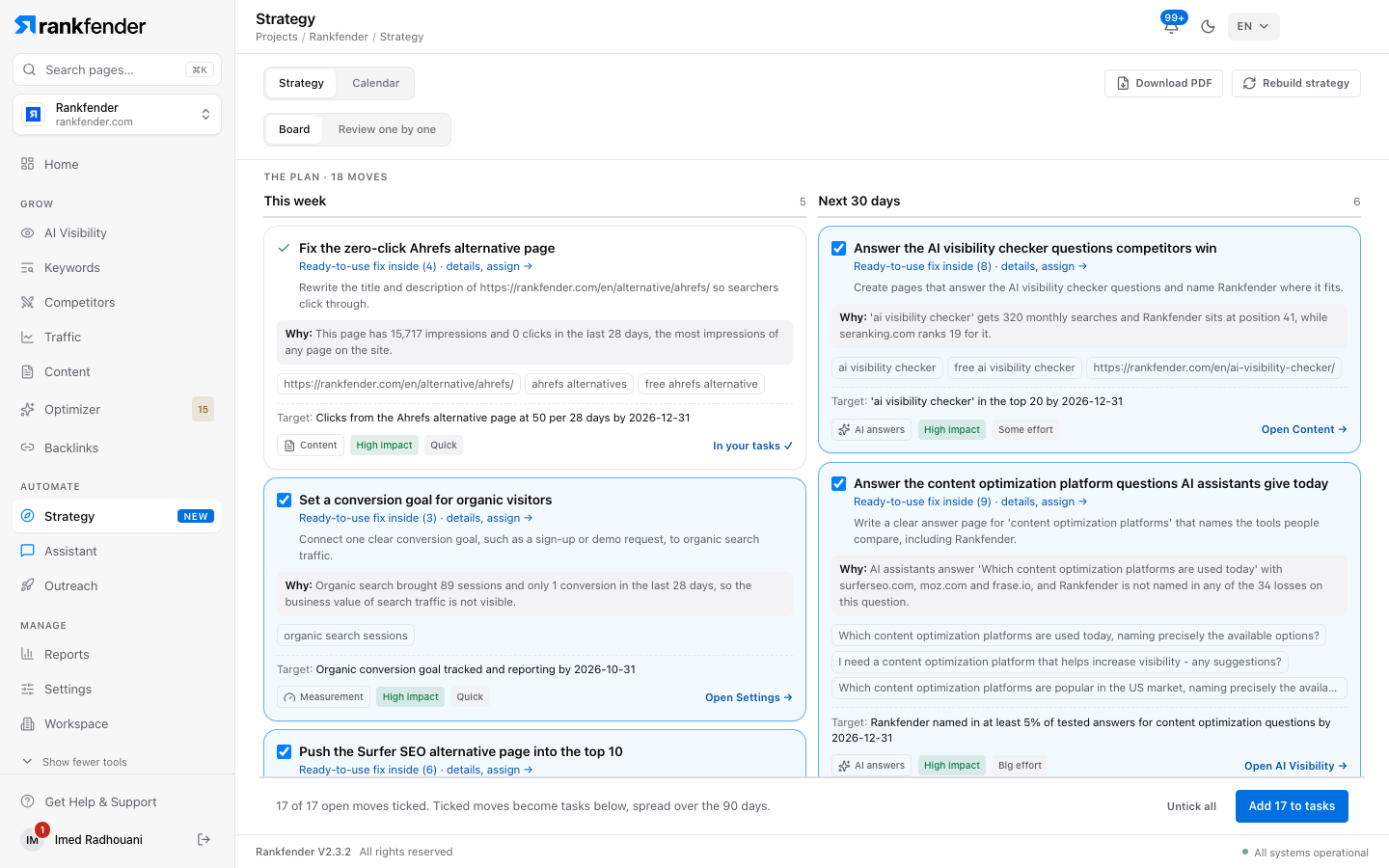
You get moves sorted into This week, Next 30 days, Days 31–60 and Days 61–90. Each one says what to do, why, how, the target, its impact and its effort.
- 04
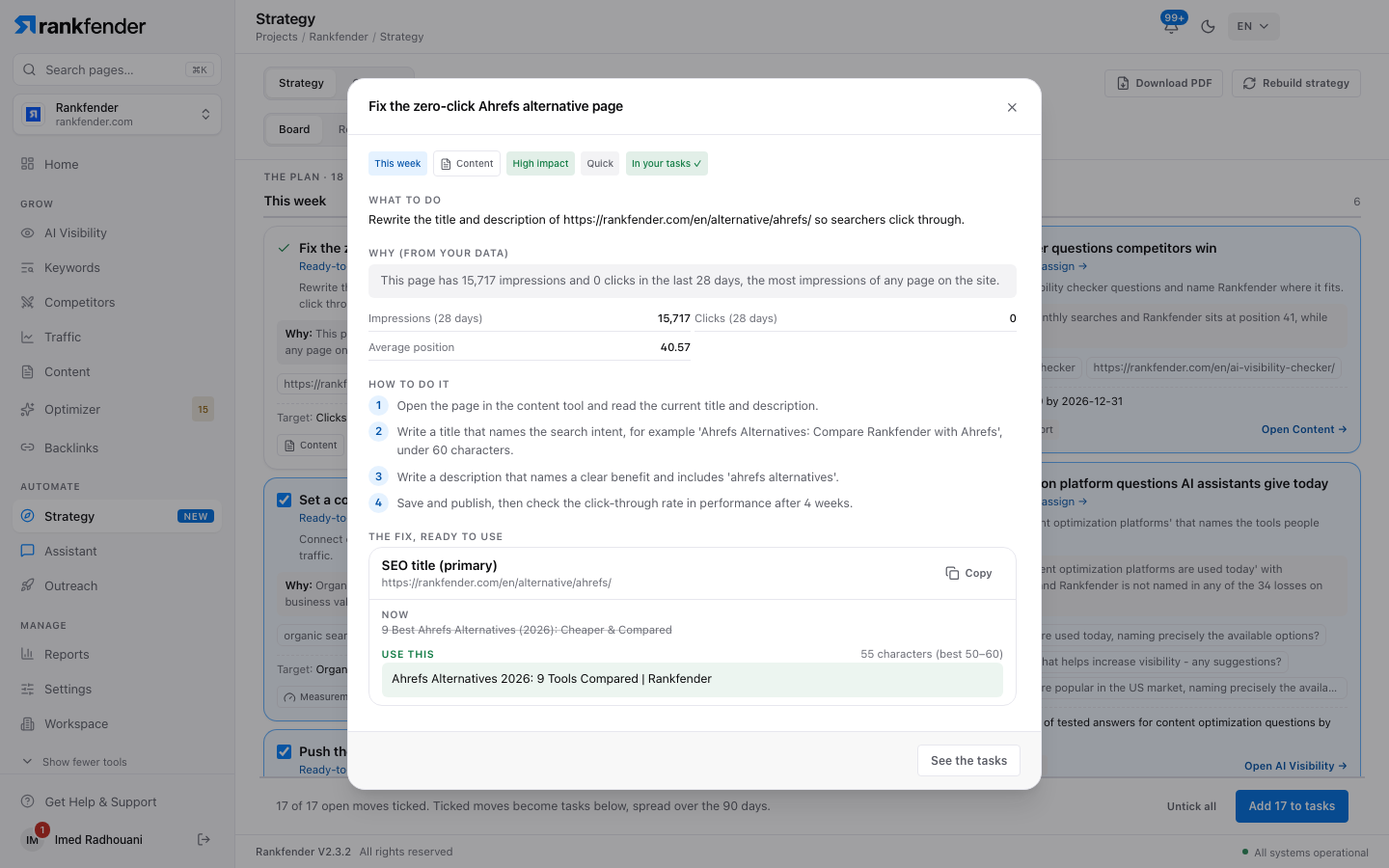
The fix, ready to use
You get the deliverables for each move, written from your live page: the current and proposed title and meta description, new copy, an outline, FAQs with their schema, an outreach email or code.
- 05
Tasks for your team
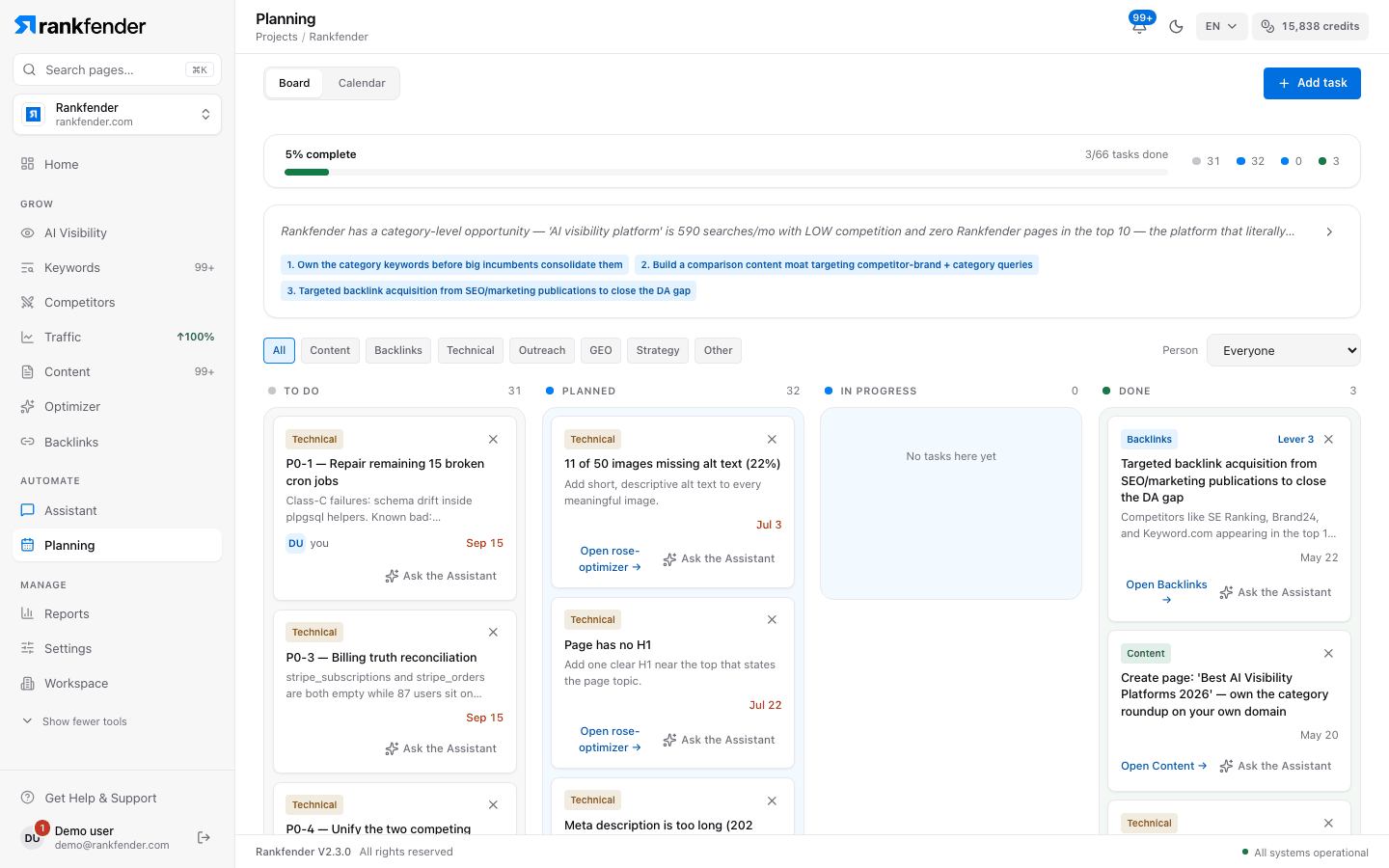
You get the moves you keep as Planning tasks, dated across their phase, with the steps and the fix inside. Assign any move to a teammate or to an email address.
- 06
A PDF to share
You get the whole strategy as a PDF in your report branding, saved in your Reports library, ready for a client, a manager or your team.
Everything the AI strategist reads before it writes
A strategy is only as good as what it knows. The AI strategist reads every source your project has, and shows each one with its count while it works.
Your keywords
- Tracked keywords and their positions
- Keyword opportunities no article targets yet
- Search Console clicks over 28 days
Your competitors
- The keywords they win and you don’t
- Their top pages
- The sites that link to them and not to you
AI answers
- What each AI assistant answers
- Which competitors they name instead of you
- The sites they cite
Your traffic
- Google Analytics visits over 28 days
- Visits from AI assistants
Site health and links
- Site audit findings and open fixes
- Referring domains and your backlink profile
Your brand and your work
- Brand book, buyer profiles and topics
- Your articles
- Open tasks, so nothing is planned twice
How the AI strategist builds your SEO strategy
Press “Build my strategy”. It takes about a minute, and you can leave the page while it works.
Read your project
A live “Reading your project” log shows each source as it is read, with a count: keywords, competitors, AI answers, traffic, audit findings, links, articles and tasks.
Measure what is missing
Competitor data that was never measured is measured once, for up to 3 competitors, from your credits. Areas with no data get a move to start measuring them.
Diagnose
Each area gets its verdict, and the strategy picks its north star: the one number to move in the next 90 days.
Write the moves
Each move says what to do and why, and the why always quotes a number from your data. Moves are spread across this week and the next 30, 60 and 90 days.
Write the fixes
For each move, Rankfender reads the live page it concerns and writes the deliverables: current against proposed, with the page they go on.
You decide
Keep the moves you want on the Board, or review them one by one. What you keep becomes Planning tasks. Nothing is changed on your site without you.
Every move says why, with your numbers
A strategy you can’t check is a strategy you can’t trust. Each move shows the evidence it was built from, so you can see why it is there and decide in seconds.
- What to do: the action, in one sentence
- Why (from your data): the finding, with the number behind it
- How to do it: the steps for your site
- Focus on: the keywords, pages or sites it concerns
- Target: the result to aim for
- Impact and effort: High impact or Low impact, Quick or Big effort
- The Rankfender tool where the work is done: Content, Keywords, Optimizer, Backlinks, AI Visibility or Traffic
Every move comes with its fix
Most strategies stop at the instruction: “improve the title”, “add an FAQ”, “get links from these sites”. Rankfender writes the work. It reads the page the move concerns and gives you up to 8 deliverables, each with the current version next to the proposed one.
Copy any of them in one click. Titles and meta descriptions show their character count against the recommended length.
- A new title, meta description, H1 and introduction
- New sections and an article outline
- FAQs, with the FAQPage schema to paste
- Internal links to add, and redirects
- An outreach email for link and mention requests
- Code and lists when the move needs them
Your strategy board, or one move at a time
The Board shows the 90 days in four columns: This week, Next 30 days, Days 31–60 and Days 61–90. Every open move starts ticked; untick what you don’t want and press “Add to Planning”. The tasks are dated across their phase.
Prefer to decide one by one? “Review one by one” shows each move with “Add to Planning” and “Skip”, with keyboard shortcuts. Open any move for the details, the steps, the fix and “Add to Planning and assign”.
From strategy to work, in the tools you already use
Accepted moves become tasks in Planning, with the steps and the fix written in the task. The next move appears in Home › Next steps, and opens straight to its details.
Keywords your competitors win that fit your offer are added to Keywords, so the content plan can start from them. Rebuild the strategy whenever your data has moved: the previous version is kept, never deleted.
Who the AI strategist is for
Business owners
Get a clear plan for the next 90 days in plain words, with the work already written. No need to read six reports to know what to do on Monday.
Marketing teams
Turn every Rankfender measurement into one prioritised plan, split it across the team and show your manager why each move is there.
Agencies
Open each client with a 90-day SEO + GEO strategy built from their own data, send it as a branded PDF and rebuild it as results come in.
In-house SEO specialists
Skip the spreadsheet. Check the evidence behind each move, keep what you agree with and hand the fixes to writers and developers.
How it differs from a typical SEO strategy
A typical SEO strategy is a document written once, from a template or a checklist. Rankfender writes it from your measured data, and the work comes with it.
| Typical SEO strategy | Rankfender Strategy | |
|---|---|---|
| Starting point | A template or an audit checklist | Every source your project measures, read before writing |
| Scope | Google rankings | Google search and AI answers, content, site health, links and competitors |
| Why each action | General best practice | A finding from your data, with the number |
| What you receive | Instructions | The fix: proposed title, copy, FAQ, schema, email or code |
| Order | Decided by hand | This week, then the next 30, 60 and 90 days, with impact and effort |
| Execution | Copied into a project tool | Planning tasks in one click, assigned to a teammate or an email |
| Updates | Rewritten by hand | Rebuilt in about a minute when your data moves |
SEO strategy terms, in one line each
SEO strategy
A prioritised plan of what to change on your site and around it to win more visits from search.
GEO
Generative engine optimization: the work that helps AI assistants understand, trust and name your brand.
North star metric
The one number a plan is built to move, so every move can be judged against it.
Quick win
A move with a high impact for little effort, such as a better title on a page that almost ranks.
Keyword gap
The keywords a competitor ranks for and you don’t.
Link gap
The sites that link to your competitors but not to you.
Use the strategy for your goal
Start a quarter
Build the strategy, keep the moves that fit your team’s time and add them to Planning. The next 90 days are planned and dated.
Catch up with a competitor
The strategy reads the keywords, pages and links a competitor wins, and turns the best gaps into moves with the page or the email ready.
Get named by AI assistants
Moves built from AI answers show which questions you lose, which sites the assistants cite instead, and what to publish or where to be mentioned.
Win a new client
Send the strategy PDF in your branding after the first meeting: where the site stands, what to do first and the fixes already written.
Strategy per plan
| Essential | Professional | Business | Agencies | |
|---|---|---|---|---|
| 90-day strategy | — | — | Yes | Yes |
| Brands | 1 | 2 | 5 | Unlimited |
| Credits a month | 1,000 | 2,000 | 5,000 | 50,000 |
| Price | $89 a month | $199 a month | $499 a month | Custom |
Building a strategy uses a few credits. Competitor data that was never measured is measured once, for up to 3 competitors. Yearly billing is about 17 % cheaper.
Frequently asked questions
What is an SEO strategy?
An SEO strategy is a prioritised plan of what to change on your site and around it to win more visits from search: which pages to write or improve, which technical issues to fix and which links to earn. Today it also covers AI answers, because many buyers ask an AI assistant before they search.
How do I build an SEO strategy?
Start from your data: the keywords you rank for and miss, what your competitors win, what AI assistants answer, your traffic, site health and links. Pick one number to move, then order the work by impact and effort. Rankfender Strategy does this in about a minute and writes the fix for each move.
What does Rankfender Strategy read?
Your brand book, buyer profiles and topics, tracked keywords and positions, keyword opportunities, competitors’ keyword gaps, top pages and linking sites, AI answers and the sites they cite, Search Console clicks, Google Analytics visits including visits from AI assistants, site audit findings, backlinks, articles and open tasks.
Which plans include Strategy?
Business and Agencies. On other plans, the Strategy page shows what it does and links to the plans.
Does it use credits?
Yes, a few. Reading and writing use a few credits, and competitor data that was never measured is measured once, for up to 3 competitors.
Does it change my site by itself?
No. The strategy proposes moves and writes the fixes. You decide what to keep: kept moves become Planning tasks that you or your team carry out, or assign to someone.
How is a move prioritised?
Each move sits in a phase (this week, then the next 30, 60 and 90 days) and shows its impact and its effort. Quick, high-impact moves come first.
Does it cover AI search as well as Google?
Yes. AI answers are one of the areas: the strategy reads which competitors AI assistants name instead of you and the sites they cite, and turns that into moves for content and mentions.
Can I share the strategy?
Yes. Download it as a PDF in your report branding; a copy is saved in your Reports library under Strategies. You can also assign single moves to a teammate or to an email address.
How often should I rebuild it?
Whenever your data has moved: after a new AI check, a competitor measurement or a month of work. Each rebuild takes about a minute, and earlier versions are kept.
Let the AI strategist write your next 90 days
It reads everything Rankfender measures for your site and writes the plan, move by move, with the fix for each one.