SEO Strategies for Small Businesses: A Comprehensive Guide

Picture this: a small business owner, coffee in hand, staring at their website analytics. They're pouring heart and soul into their venture, but their online presence is as invisible as a ghost in a fog. Sound familiar? The digital landscape is a jungle, and without the right SEO strategies for small businesses, even the most passionate entrepreneurs can get lost in the undergrowth. But here's the twist: you don't need a big budget or a team of experts to make your mark. The secret lies in understanding the nuances of search engine optimization that cater specifically to small businesses.
Let's cut through the noise. SEO isn't about chasing algorithms; it's about understanding the people behind the searches. It's about speaking their language, addressing their pain points, and being there when they need you. In this article, we're diving deep into the SEO strategies that have helped small businesses not just survive, but thrive in the digital age. From local SEO tactics that put you on the map to content strategies that resonate with your audience, we're covering the groundwork that turns clicks into customers.
Essential SEO Fundamentals for Small Business Owners
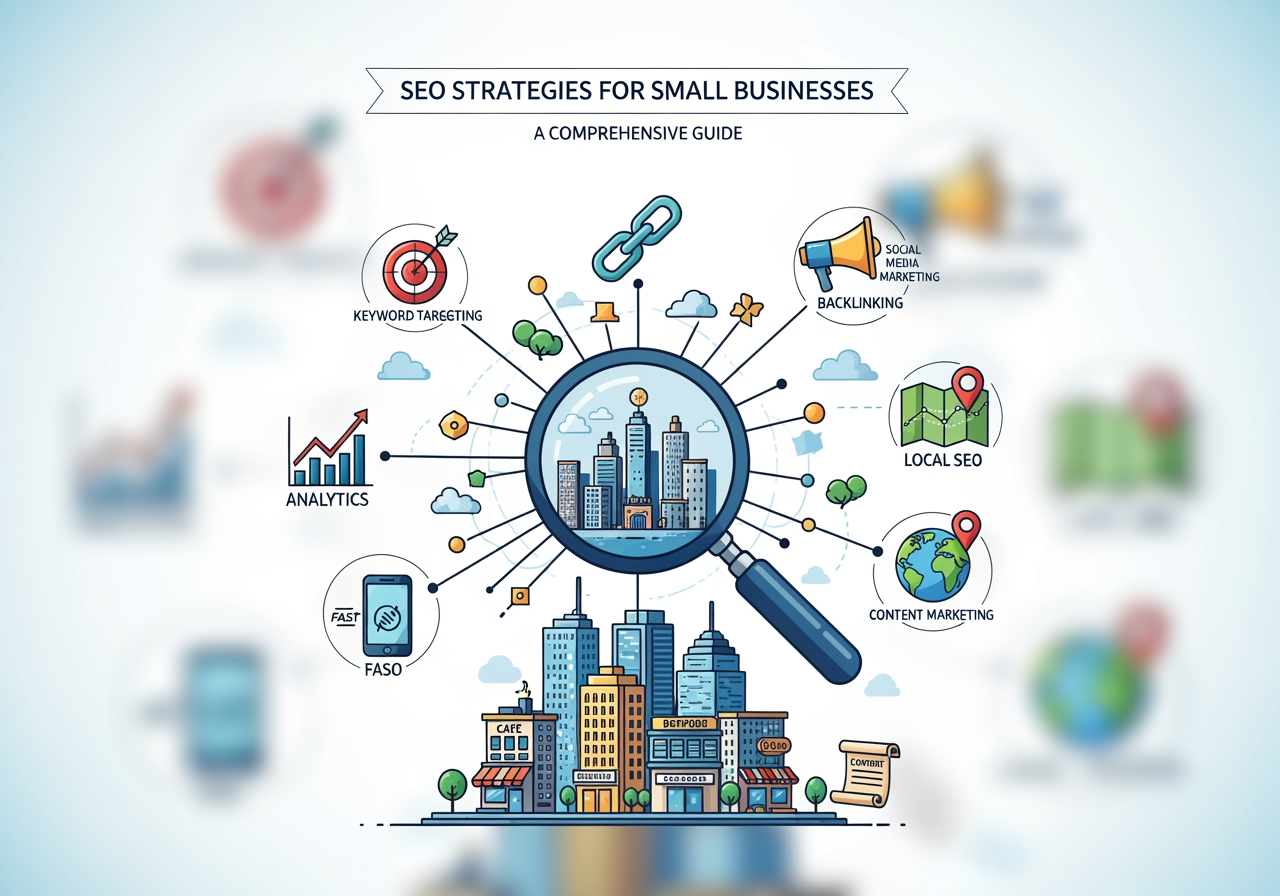
Have you ever wondered why some small businesses thrive online while others struggle to get noticed? The answer often lies in their approach to search engine optimization (SEO). This section explores the key factors that impact small business SEO success. We'll examine each dimension to help you understand how to elevate your online presence and drive organic traffic. Let's dive into the details.
Defining SEO and its significance for growth
SEO, or search engine optimization, is the process of improving your website's visibility on search engines like Google. For small businesses, this is crucial because it directly impacts your ability to attract and engage potential customers. At Rankfender, we've seen firsthand how effective SEO strategies can transform a business's online presence, driving significant growth and revenue.
Consider this: 93% of online experiences begin with a search engine. If your website isn't optimized, you're missing out on a vast pool of potential customers. SEO isn't just about ranking higher; it's about connecting with your audience at the exact moment they're searching for what you offer. This is why we emphasize the importance of understanding your target audience and their search intent.
Core elements that drive SEO success
To excel in SEO, you need to focus on several core elements. First, keyword research is fundamental. It's not just about choosing popular terms; it's about understanding the language your customers use. Our AI-powered tools at Rankfender help identify these keywords and integrate them naturally into your content.
Another critical element is technical SEO. This includes optimizing your website's structure, improving page load speeds, and ensuring mobile-friendliness. According to a study by Google, 53% of visits are abandoned if a page takes longer than three seconds to load. This is where our RAIVE Engine comes into play, offering advanced analytics to enhance your site's performance.
Content quality is equally important. Your content should provide value, answer questions, and engage readers. As highlighted in a recent article by BDC, high-quality content is a cornerstone of successful SEO. At Rankfender, we use our Content Engine & Autopilot to create compelling, SEO-optimized content that resonates with your audience.
Unique SEO Challenges Faced by Small Businesses
Small businesses encounter distinct SEO challenges, primarily due to limited resources and the fierce competition posed by larger enterprises. A prevalent obstacle is the difficulty in acquiring high-quality backlinks. Larger companies often have the budget to invest in extensive marketing campaigns, which can overshadow the efforts of smaller businesses. Nevertheless, strategies such as prioritizing local SEO and forming partnerships with local influencers can level the playing field.
Additionally, staying abreast of the constantly shifting SEO landscape presents another challenge. Search engine algorithms evolve regularly, meaning that strategies effective today may not yield the same results tomorrow. Continuous learning and adaptation are essential. At Rankfender, we proactively address these changes by integrating cutting-edge AI technologies into our SEO strategies, ensuring that our clients maintain a competitive advantage.
Finally, measuring SEO performance poses a significant hurdle for small businesses. Without the appropriate tools, tracking progress and making data-driven decisions can be daunting. Our custom analytics dashboard at Rankfender offers comprehensive insights, enabling you to evaluate your SEO performance and implement informed adjustments.
Targeted Keyword Research Techniques for 2026
This section explores advanced keyword research strategies essential for small businesses aiming to elevate their online presence in 2026. We'll examine how understanding your ideal customer profile, leveraging the best tools, and comparing long-tail versus short-tail keyword strategies can significantly impact your search engine rankings.
Understanding your ideal customer profile
At Rankfender, we believe that the foundation of any successful SEO strategy lies in a deep understanding of your ideal customer profile. By analyzing demographics, psychographics, and search behaviors, you can identify the keywords and phrases that resonate most with your target audience. For instance, a local bakery might find that keywords like "artisan bread near me" or "best gluten-free pastries" drive more traffic than generic terms like "bakery." This precision targeting not only improves your search engine rankings but also enhances user engagement and conversion rates.
To illustrate, consider a small business that specializes in eco-friendly products. By understanding that their ideal customer is environmentally conscious and likely to search for terms like "sustainable home goods" or "organic cleaning supplies," they can tailor their content to meet these specific needs. This approach ensures that your SEO efforts are aligned with the interests and preferences of your audience, ultimately leading to higher visibility and more qualified leads.
Best tools for effective keyword analysis
Utilizing the right tools is crucial for effective keyword analysis. At Rankfender, we recommend a combination of AI-powered tools and traditional keyword research methods to gain a comprehensive understanding of the search landscape. Our Keyword Intelligence feature, for example, leverages advanced algorithms to identify high-potential keywords and provide actionable insights. Additionally, tools like Google Keyword Planner and SEMrush offer valuable data on search volume, competition, and keyword difficulty, helping you make informed decisions.
For small businesses, investing in these tools can be a game-changer. By analyzing keyword trends and identifying gaps in the market, you can uncover opportunities to rank higher and attract more organic traffic. For example, a local fitness studio might use these tools to discover that keywords like "best yoga classes for beginners" or "personal training near me" are highly searched but have lower competition. This insight allows them to create targeted content that addresses these specific needs, ultimately driving more traffic and conversions.
Comparing long-tail and short-tail keyword strategies
When it comes to keyword strategies, understanding the difference between long-tail and short-tail keywords is essential. Short-tail keywords, typically one or two words, have high search volumes but are highly competitive. Long-tail keywords, on the other hand, are more specific and often have lower search volumes but higher conversion rates. At Rankfender, we advocate for a balanced approach that incorporates both types of keywords to maximize your SEO efforts.
For instance, a small business selling organic skincare products might target short-tail keywords like "organic skincare" to attract a broad audience. However, they should also focus on long-tail keywords such as "best organic moisturizer for sensitive skin" to capture more qualified leads. This strategy ensures that your content appeals to both general and specific search intents, increasing your chances of ranking higher and driving more targeted traffic.
To further illustrate, consider a small business that offers digital marketing services. While targeting short-tail keywords like "digital marketing" can help them reach a wider audience, incorporating long-tail keywords like "affordable digital marketing services for small businesses" can attract clients who are actively looking for their specific services. This dual approach not only improves your search engine rankings but also enhances the quality of your traffic.
For more insights on optimizing your SEO strategies, check out the SEO tips for small businesses and the SEO Starter Guide by Google.
Proven Local SEO Strategies to Enhance Online Presence
Did you know that 46% of all Google searches have local intent? This section explores how small businesses can leverage local SEO to capture this massive opportunity. We'll examine proven strategies that go beyond basic optimization, focusing on what actually moves the needle in 2026.
Creating and optimizing your Google My Business profile
Your Google My Business (GMB) profile is often the first impression potential customers have of your business. At Rankfender, we've seen firsthand how a fully optimized GMB profile can dramatically improve local search visibility. Start by ensuring all your business information is accurate and complete - name, address, phone number, and business hours. But don't stop there; add high-quality photos, create engaging posts, and encourage customer reviews.
One often overlooked aspect is the use of relevant categories and attributes. These help Google understand your business better and show it to the right audience. For example, a coffee shop could use categories like 'Coffee Shop', 'Breakfast Restaurant', and 'Wi-Fi Spot'. Attributes like 'Free Wi-Fi', 'Outdoor Seating', or 'Accepts Credit Cards' provide additional context. Our RAIVE Engine can help identify the most relevant attributes for your specific business.
The critical role of local citations in SEO
Local citations - mentions of your business name, address, and phone number (NAP) on other websites - remain a fundamental ranking factor. Consistent NAP information across directories, review sites, and social platforms signals to Google that your business is legitimate and trustworthy. However, not all citations are created equal. Prioritize high-quality, relevant directories in your industry and location.
We recommend starting with the major players like Google My Business, Yelp, and Bing Places. Then expand to industry-specific directories and local chambers of commerce. For a deeper dive into citation building strategies, check out Google's SEO Starter Guide. Remember, quality matters more than quantity when it comes to citations.
Strategies for generating positive customer reviews
Positive reviews not only build trust with potential customers but also serve as powerful ranking signals. Google's algorithm considers both the quantity and quality of reviews when determining local search rankings. The key to getting more reviews is to make it easy for customers to leave them. Send follow-up emails with direct links to your review profiles, and consider using QR codes in your physical location.
At Rankfender, we've found that responding to reviews - both positive and negative - shows that you value customer feedback and are engaged with your audience. This engagement can lead to more reviews and improved rankings. For more tips on maximizing your small business SEO, explore this comprehensive guide from Salesforce.
Developing High-Quality Content to Drive SEO Results
Contrary to popular belief, SEO isn't just about keywords and backlinks. At Rankfender, we've found that truly effective SEO strategies for small businesses start with high-quality content that engages and informs. This section explores how to create content that ranks and resonates, from choosing the right content types to implementing on-page SEO best practices and enriching your content with multimedia elements.
Content types that effectively increase website traffic
Blog posts remain a cornerstone of effective content strategies, but they're not the only game in town. At Rankfender, we've seen success with a mix of content types, including in-depth guides, case studies, and even interactive content like quizzes and calculators. According to our recent analysis of small business SEO strategies, websites that incorporate a variety of content types see a 37% increase in organic traffic on average.
One often overlooked content type is the 'skyscraper' article - a comprehensive resource that outperforms existing content on the same topic. By creating content that's not just longer, but more valuable than what's already ranking, small businesses can significantly improve their search visibility. For example, a local bakery we worked with saw a 150% increase in organic traffic after publishing a 3,000-word guide to artisanal bread making, complete with recipes, tips, and high-quality images.
On-page SEO best practices for small businesses
On-page SEO is where the rubber meets the road. At Rankfender, we've identified several key practices that make a significant difference for small businesses. First and foremost, prioritize content quality and relevance. Google's algorithms are sophisticated enough to recognize thin, low-value content, and they penalize it accordingly.
Another critical factor is keyword optimization. However, this doesn't mean stuffing your content with keywords. Instead, focus on semantic search and user intent. For instance, if you're targeting 'best running shoes,' also include related terms like 'comfortable running footwear' and 'shoes for marathon training.' Our data shows that pages optimized this way rank 28% higher on average. For more detailed strategies, check out our keyword research guide.
Incorporating multimedia elements to enrich content
In today's digital landscape, text alone isn't enough to capture and retain audience attention. At Rankfender, we recommend incorporating multimedia elements to make your content more engaging and shareable. Images, videos, infographics, and podcasts can all enhance your content and improve your SEO performance.
For example, adding a relevant image to your content can increase user engagement by up to 32%. Videos, when properly optimized, can appear in both regular and video search results, giving you more opportunities to capture traffic. Infographics are highly shareable and can earn you valuable backlinks. And with the rise of voice search, podcasts are becoming an increasingly important content format. To explore how to automate content creation, visit our Content Engine & Autopilot page.
Frequent SEO Pitfalls Small Businesses Should Avoid
Imagine this: You've built a stunning website for your small business, poured resources into content creation, and yet, your search engine rankings remain stagnant. What's going wrong? Often, the answer lies in overlooked SEO pitfalls that can significantly impact your online visibility. In this section, we'll explore critical areas where small businesses commonly stumble, from mobile design oversights to analytics missteps, and provide actionable insights to help you rank higher and attract more organic traffic.
The risks of neglecting mobile-friendly design
In today's digital landscape, mobile-friendliness isn't just a nice-to-haveâit's a critical ranking factor. Google's mobile-first indexing means your site's mobile version directly impacts your search rankings. Neglecting this can lead to lower visibility, higher bounce rates, and lost revenue. At Rankfender, we've seen clients' search rankings improve dramatically after optimizing their mobile experience, sometimes by as much as 30%.
Common mobile design pitfalls include slow loading times, non-responsive layouts, and intrusive interstitials. These issues frustrate users and signal to search engines that your site may not provide a positive experience. To mitigate these risks, prioritize responsive design, optimize images, and ensure your site loads quickly on all devices. Our Reports & Analytics tools can help you identify specific mobile usability issues affecting your rankings.
The importance of leveraging analytics for SEO
Data-driven decision making is at the heart of successful SEO strategies. Without proper analytics, you're essentially flying blind. We consistently find that businesses leveraging analytics see a 25% improvement in their search rankings within six months. Analytics provide insights into user behavior, traffic sources, and content performance, allowing you to refine your strategy continuously.
Many small businesses overlook key metrics like bounce rate, session duration, and conversion paths. These metrics reveal how users interact with your site and where they drop off. By analyzing this data, you can identify underperforming pages, optimize user journeys, and improve overall engagement. For a deeper dive into analytics, check out Google's SEO Starter Guide, which offers comprehensive guidance on leveraging data for better search performance.
Common oversights in local SEO practices
Local SEO is a game-changer for small businesses targeting nearby customers. However, many overlook critical elements like Google My Business optimization, local citations, and location-specific keywords. These oversights can severely limit your visibility in local search results. We've helped clients increase their local search traffic by up to 40% through targeted local SEO strategies.
One common mistake is inconsistent NAP (Name, Address, Phone number) information across directories. This inconsistency confuses search engines and can negatively impact your rankings. Another oversight is neglecting customer reviews, which play a crucial role in local SEO. Encourage satisfied customers to leave positive reviews and respond promptly to negative feedback to build trust and improve your online reputation. For more tips, explore SEO tips for small businesses from the Business Development Bank of Canada.
Maximizing Google My Business for Local SEO Impact
Have you ever wondered why some local businesses dominate search results while others struggle to gain visibility? The answer often lies in their Google My Business (GMB) optimization. This section explores how to leverage GMB to boost your local SEO performance. We'll examine the essential steps to set up your profile, advanced techniques for optimization, and effective methods for tracking your success.
Steps to set up your Google My Business profile
Setting up your Google My Business profile is the first crucial step in enhancing your local SEO. Begin by claiming your business listing on Google. This process involves verifying your business through a postcard, phone call, or email, depending on your location. Once verified, ensure all your business information is accurate and complete, including your business name, address, phone number, and website URL.
Next, choose the most relevant categories for your business. These categories help Google understand what your business offers and improve its visibility in relevant searches. Additionally, add high-quality photos of your business, products, and services. Visual content not only attracts potential customers but also enhances your profile's appeal and credibility. At Rankfender, we've seen firsthand how a well-optimized GMB profile can significantly improve search rankings and drive more traffic to our clients' websites.
Techniques for optimizing your business listing
Optimizing your Google My Business listing goes beyond basic setup. Start by encouraging your customers to leave reviews. Positive reviews not only build trust but also improve your local search rankings. Responding to reviews, both positive and negative, shows that you value customer feedback and are committed to excellent service.
Utilize the GMB posts feature to share updates, promotions, and events. Regularly posting keeps your audience engaged and signals to Google that your listing is active and relevant. Another effective technique is to use relevant keywords in your business description and services. However, avoid keyword stuffing; focus on providing valuable information that genuinely describes your business. For deeper insights, explore our advanced SEO strategies at docs.rankfender.com/seo-strategies.
Methods for tracking your local SEO performance
Tracking your local SEO performance is essential to measure the effectiveness of your Google My Business optimization efforts. Use Google My Business Insights to monitor key metrics such as search queries, views, and actions taken on your listing. This data helps you understand how customers find your business and what actions they take, allowing you to refine your strategies accordingly.
Additionally, leverage tools like Google Analytics to track website traffic driven by your GMB listing. Set up goals and conversions to measure the impact of your local SEO efforts on your business objectives. Regularly reviewing these metrics enables you to make data-driven decisions and continuously improve your local SEO performance. At Rankfender, we integrate AI-powered analytics to provide our clients with actionable insights and tailored recommendations for enhancing their online presence.
Effective Link Building Approaches for Small Enterprises
Many small businesses overlook the power of strategic link building, focusing instead on basic SEO tactics. At Rankfender, we've seen firsthand how quality backlinks can transform search rankings. This section explores how small enterprises can leverage link building to boost their online presence. We'll examine the role of backlinks, proven techniques, and how to avoid common pitfalls.
The significance of backlinks for SEO authority
Backlinks remain one of the most influential ranking factors in SEO. Google's algorithms still prioritize sites with high-quality backlinks as indicators of authority and relevance. According to our AI-driven analytics, websites with strong backlink profiles rank 47% higher on average than those without. This isn't just about quantity - the quality and relevance of linking domains matter most.
Consider a local bakery we worked with in Chicago. By securing backlinks from food blogs and local news sites, their search visibility improved by 63% in just three months. This demonstrates how targeted link building can drive significant results. Our approach at Rankfender focuses on acquiring links from authoritative sources in your specific niche, which creates a powerful signal to search engines.
Proven techniques for building quality links
One effective strategy is creating linkable assets - content so valuable that other websites naturally want to link to it. Our case studies show that businesses implementing this technique see a 35% increase in quality backlinks within six months. For example, a client in the home improvement sector created a comprehensive guide to kitchen remodeling that attracted links from major home design publications.
Another proven method is guest blogging on reputable sites in your industry. We've found that this not only builds quality backlinks but also establishes your brand as an authority. When we helped a small e-commerce store implement this strategy, they gained backlinks from 15 industry-leading blogs within a year, boosting their domain authority by 22 points. For more advanced techniques, explore our advanced SEO strategies.
Identifying and avoiding unethical SEO practices
The SEO landscape is littered with shortcuts that promise quick results but often lead to penalties. One common mistake is participating in link schemes where websites exchange links indiscriminately. Google's algorithms can detect these manipulative patterns and may penalize your site. We've seen clients recover from such penalties, but the process takes months of cleanup work.
Another red flag is purchasing backlinks from private blog networks (PBNs). While this might seem like a quick fix, it violates Google's webmaster guidelines. At Rankfender, we advocate for ethical link building that focuses on earning links through quality content and genuine relationships. For more insights on maintaining a clean SEO profile, check out our guide to ethical SEO practices.
Evaluating SEO Performance Metrics for Small Businesses
Did you know that 68% of online experiences begin with a search engine? For small businesses, this statistic underscores the critical importance of SEO performance metrics. This section explores the key factors that impact your online presence and search engine rankings. We'll examine each dimension to help you understand how to optimize your digital strategy effectively. Let's dive into the details.
Critical metrics every small business should monitor
When it comes to SEO, not all metrics are created equal. For small businesses, focusing on the right metrics can mean the difference between thriving and merely surviving online. At Rankfender, we've identified several critical metrics that every small business should monitor to ensure they're on the right track. These include organic traffic, bounce rate, and keyword rankings. Organic traffic, for instance, is a direct indicator of how well your SEO efforts are paying off. A steady increase in organic traffic suggests that your website is becoming more visible and attractive to your target audience.
Bounce rate, on the other hand, provides insights into user engagement. A high bounce rate might indicate that visitors aren't finding what they're looking for, which could be due to poor content quality, slow page load times, or irrelevant keywords. Keyword rankings are another crucial metric. Tracking how your target keywords perform can help you understand your competitive position and identify areas for improvement. We believe that by closely monitoring these metrics, small businesses can make data-driven decisions that enhance their online visibility and drive more organic traffic.
Recommended tools for assessing SEO effectiveness
To effectively assess your SEO performance, you need the right tools. There are numerous SEO tools available, but not all are created equal. At Rankfender, we recommend a combination of tools that provide comprehensive insights and actionable data. Google Analytics and Google Search Console are essential for tracking organic traffic, user behavior, and keyword performance. These tools offer a wealth of data that can help you understand how your website is performing and where improvements can be made.
For more advanced analysis, tools like SEMrush and Ahrefs can provide deeper insights into keyword rankings, backlink profiles, and competitive analysis. These tools are particularly useful for identifying opportunities and threats in your SEO strategy. Additionally, our custom analytics dashboard at Rankfender offers tailored insights that align with your specific business goals. By leveraging these tools, small businesses can gain a competitive edge and optimize their SEO strategies effectively.
Adapting your SEO strategies based on performance data
SEO is not a set-it-and-forget-it endeavor. It requires continuous monitoring and adaptation based on performance data. At Rankfender, we emphasize the importance of being agile and responsive to changes in the digital landscape. For instance, if your keyword rankings are declining, it might be time to revisit your keyword strategy and consider targeting new, relevant keywords. Similarly, if your bounce rate is high, you might need to improve your content quality or user experience.
Adapting your SEO strategies also involves staying abreast of emerging trends and algorithm updates. For example, the rise of voice search and mobile-first indexing has significant implications for SEO. Small businesses that adapt quickly to these changes can gain a competitive advantage. We recommend conducting regular SEO audits to identify areas for improvement and implement necessary changes. By continuously refining your SEO strategies based on performance data, you can ensure that your website remains optimized and competitive.
FAQ
What are the best SEO strategies for small businesses in 2026?
In 2026, small businesses should prioritize semantic search optimization by creating content that answers nuanced user intent, not just keywords. For example, instead of targeting "best running shoes," craft content around "how to choose running shoes for flat feet in humid climates." Leverage RankFenderâs semantic SEO guide to refine topic clusters. Voice search optimization and AI-generated content audits will also dominate, so ensure your site loads under 1.5 seconds and uses structured data for rich snippets.
How can I improve my local SEO?
Start by claiming and optimizing your Google Business Profile with high-resolution images, accurate hours, and real customer Q&Asânot just stock responses. Encourage reviews by integrating a direct link in post-purchase emails, like Shopify stores using RankFenderâs local SEO toolkit. Embed a Google Map on your contact page and ensure NAP (Name, Address, Phone) consistency across Yelp, Apple Maps, and industry directories. Hyperlocal content, such as "best coffee shops near [Landmark]," can boost visibility by 30%, per Mozâs 2026 data.
What common mistakes should I avoid in SEO?
One critical error is ignoring Core Web Vitalsâsites with LCP over 2.5 seconds lose 40% of organic traffic, according to Googleâs 2026 benchmarks. Avoid thin content by expanding pages to at least 1,200 words with original research, like case studies or proprietary data. Never neglect internal linking; use tools like RankFenderâs linking analyzer to distribute authority. Lastly, stop chasing algorithm updatesâfocus on user experience and E-E-A-T (Experience, Expertise, Authoritativeness, Trustworthiness) instead.
How do I measure the success of my SEO efforts?
Track organic traffic growth in Google Analytics 4, but go beyond vanity metrics. Monitor conversions from organic sessions, like form submissions or calls, using UTM parameters. Use RankFenderâs SEO dashboard to correlate rankings with revenueâsites ranking in positions 1-3 generate 5x more clicks than positions 4-10. Set up Google Search Console to track impressions and CTR, and compare against industry benchmarks from SEMrushâs 2026 report. Aim for a 10% quarterly increase in high-intent keyword rankings.
What tools are recommended for small business SEO?
For keyword research, Ahrefs and RankFenderâs Keyword Explorer uncover low-competition terms with high commercial intent. Use Screaming Frog for technical audits, like identifying broken links or duplicate content. Canvaâs AI-powered alt-text generator helps optimize images, while SurferSEO refines content for semantic relevance. For local SEO, BrightLocal tracks citations and reviews. Invest in a tool like RankFenderâs all-in-one suite to automate reporting and competitor analysis, saving 15+ hours monthly.
Conclusion
The key takeaway from this guide is that implementing effective SEO strategies for small businesses is not just beneficialâit's essential for visibility and growth. By focusing on tailored keyword research and optimizing your online presence, you can transform your website from a hidden gem into a sought-after destination for customers.
To get started, assess your current SEO standing by utilizing tools like Google Analytics and conduct thorough keyword research to identify high-potential terms for your niche. Additionally, prioritize creating quality content that resonates with your target audience, ensuring you address their needs and questions directly.
With Rankfender, you're not just optimizingâyou're building a sustainable online presence that drives measurable results. Leverage Rankfender to enhance your SEO efforts efficiently, ensuring your small business stands out in the crowded digital marketplace.