Key takeaways
- Strong SEO fundamentals such as crawlability, authority and structured content usually also help pages appear in generative AI answers.
- Well-executed SEO strategies can improve AI visibility, but they do not form a complete GEO strategy on their own.
- AI crawlers often do not render JavaScript, so content hidden behind scripts may be invisible to them.
- AI visibility should be tested directly by asking the same questions across several assistants and recording which pages they cite.
- Brand mentions in third-party sources can shape AI answers, so GEO work may need a separate track beyond the owned website.
Does Strong Traditional SEO Also Win Visibility in AI Answers?
Largely, yes. Nearly every good SEO strategy, properly executed, can help a brand appear in AI-generated answers, which is why the phrase "good SEO is good GEO" holds up as a working principle. It does not hold up as a complete strategy. Generative engines draw on high-ranking, authoritative pages, so the fundamentals of crawlability, authority and clear structure carry over. The gaps appear where AI answers draw on sources and surfaces that classic ranking never measured.
Why well-executed SEO strategies usually lift AI visibility too
Zyppy's claim that "nearly every single good SEO strategy, properly executed, can help you with AI visibility" works best as a test rather than a promise, since strong SEO fundamentals tend to carry over to AI answers. For each SEO initiative, ask two questions: does it improve how a page ranks, and does it make the page easier for an AI system to retrieve, read and cite? Content that is crawlable, authoritative and well structured usually passes both checks. Digiday's reporting on GEO vendors makes the same point from the practitioner side: LLMs often pull from high-ranking, authoritative pages, so the ranking signals that drive search results also shape what gets summarised.
The overlap has limits. Zyppy also argues that AI has opened optimisation surfaces that did not exist in the traditional SEO era, such as third-party mentions and brand signals that feed AI answers. Those surfaces reward signals that a ranking report does not show. If you only measure position, you will miss them. For example, a site that ranks well for a category term but is rarely named in third-party coverage may still be absent from AI answers about that category.
Which Traditional SEO Foundations Carry Over to AI-Generated Answers?
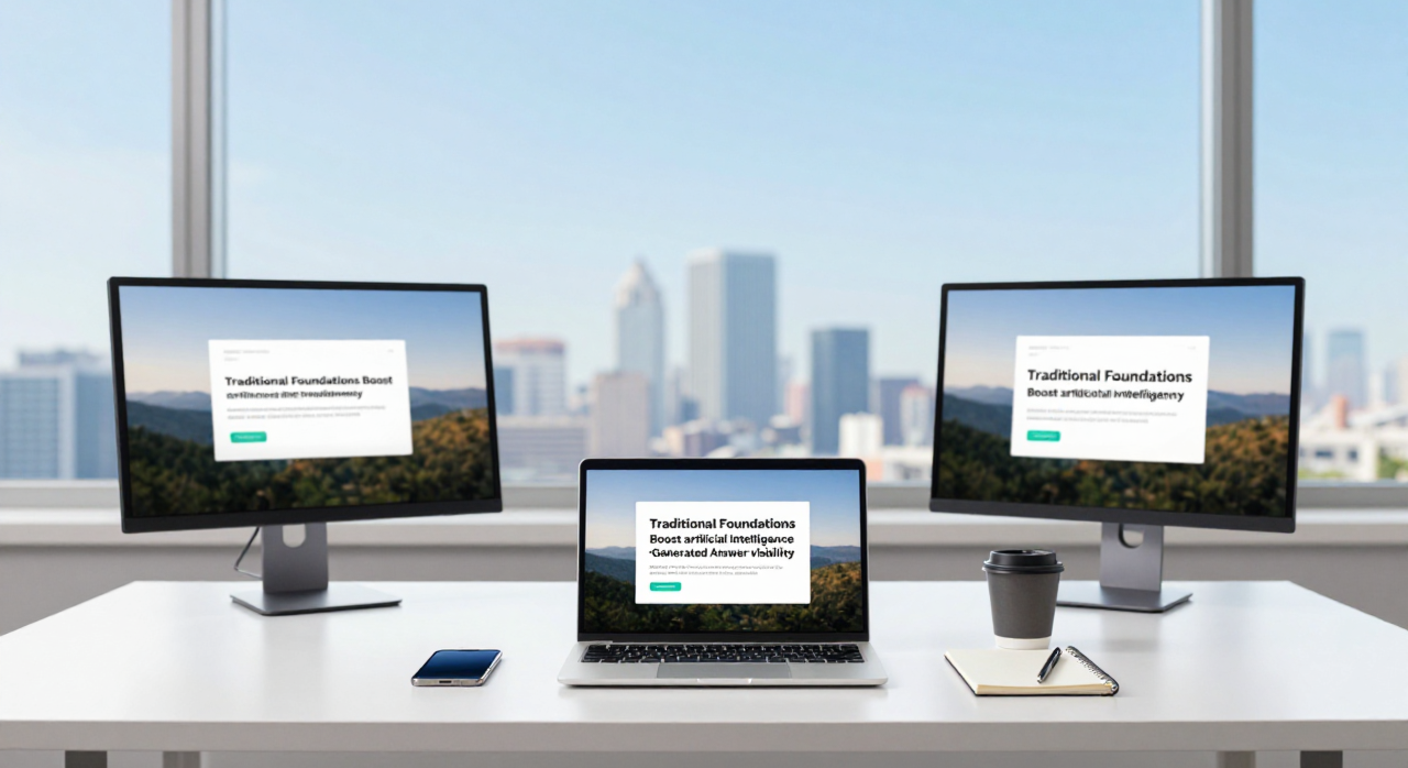
Most of the SEO work that matters for AI answers is the same work that matters for ranking. zyppy's three groupings give a usable frame: make content AI eligible, win citations, and get recommended inside AI answers. For each, the traditional practice still applies, but the test changes. In search, you measure a position for a keyword. In AI answers, you measure whether a page is named or cited for the same question across assistants. GEO vs SEO covers where the two strategies overlap in more detail.
Structuring pages so AI assistants can pull clear answers
Crawlability and clean markup are the first requirement. zyppy notes that AI systems often build their data from seed sources such as Common Crawl, and that many AI crawlers do not render JavaScript, so content hidden behind scripts may be invisible to them. Run the same crawl and render checks you use for Google here, with more frequent audits. Clear headings, direct answers near the top of each section, and facts stated in plain sentences make extraction easier. Google's own guidance on how search works is the reference point for these basics: Google Search Central, How Google Search works .
Getting pages cited as sources inside AI-generated answers
Authority still decides which pages get cited. pureseo argues that GEO and SEO work together, and Digiday's sources point to LLMs pulling from high-ranking, authoritative content. A common mistake is to treat citation as a separate game. For example, a page with thin, unsourced claims may rank for a long-tail query but never be cited, because the assistant has better-supported material to draw on. Test this directly: ask the same question across several assistants, record which pages are cited, and compare them with your ranking pages.
| Traditional SEO task | AI visibility outcome it supports | What changes in AI answers |
|---|---|---|
| Crawlability and rendering checks | Content is available to AI crawlers | Audits need to run more often |
| Clear headings and direct answers | Passages are easy to extract | Answers are assembled, not ranked |
| Authority and link building | Pages are selected as sources | Citation replaces position as the goal |
| Structured, up-to-date content | Pages are recommended in answers | Recommendation is measured per question |
The exception: if your audience mostly asks questions that have no clear answer on the open web, such as proprietary pricing or internal product details, a well-optimized page may still not be cited. In that case, the work shifts from ranking to supplying the missing facts.
What Does Generative Engine Optimisation (GEO) Add to Traditional SEO?
Generative engine optimisation, usually shortened to GEO, is the practice of making a brand's content retrievable, understandable and citable by AI answer systems such as ChatGPT, AI Overviews, Bing Chat and Perplexity AI (GEO: Generative Engine Optimization (Aggarwal et al., arXiv ). Those systems do not return a ranked list of links. They synthesise an answer from several sources, so the question shifts from "where do I rank?" to "am I one of the sources the answer is built from?" GEO adds that second question on top of traditional SEO rather than replacing the first.
How the generative engine optimization definition is framed in industry coverage
Digiday defines the term as "short for 'generative engine optimization', a growing number of vendors are pitching their GEO services to optimize content for chatbots and AI search engines." That definition describes a service category, and it is worth reading with caution, because the label is new and vendors use it broadly. Pureseo frames the same shift by listing the AI tools that now change how people search, including ChatGPT, AI Overviews, Bing Chat and Perplexity AI, and by describing SEO as competing for ranked positions while GEO focuses on whether AI tools recognise and use a page in their responses.
Read together, the two definitions show the common ground and the difference. Both depend on content that search systems can find and trust. Where they diverge is the output: a ranked result sends a click, while an AI answer may cite a source with no click at all. For a page that already ranks well, the practical question is whether its facts are stated clearly enough to be lifted into an answer. For a page that does not rank, traditional SEO work still comes first, because retrieval is the entry point for both systems.
- Traditional SEO measures rank position and organic clicks.
- GEO measures whether an AI assistant mentions or cites the brand for a question.
- Both rely on crawlability, authority and clearly structured content.
- Only the GEO question is answered without a visit to your site.
Where Do AI Visibility Tasks Diverge From Traditional Search Rankings?
Which new AI answer surfaces need work beyond classic SEO pages
The sources point to surfaces outside the owned website. Zyppy mentions email influence and an AI Brand Authority Database as areas where optimisation has opened up, though the article has not verified how AI systems use brand signals or whether any particular Google system uses them. Pureseo's heading "Influencing AI: From Keyword Optimisation to Brand Authority" makes the same move from page-level keyword work to entity-level authority. A team can assess which of these matter for its own brand by checking what the AI answers actually cite for the questions its buyers ask. If the citations point to third-party reviews or directories, that surface needs work; if they point to the brand's own documentation, the owned site is still the main lever. This is a test to run, not a rule to assume.
A checklist of what carries over and what needs separate work
Work that carries over: crawlability, clear page structure, factual accuracy and authority signals. Work that needs a separate track: presence in the third-party sources AI systems draw on, and brand mentions in contexts you do not control.
Which Common GEO Promises Fail When Tested Against Real AI Answers?
Several GEO claims sound compelling until someone checks them against actual assistant output. Digiday's myth list is a useful starting point: vendors often promise that specific tactics guarantee AI mentions, that AI visibility can be tracked clearly, or that AI visibility is simply the new traffic. None of these holds without a checking method. A claim is only as good as the test behind it, and most GEO pitches never state what was tested, on which assistants, or how often.
Why no single GEO tactic can guarantee a mention in AI answers
AI assistants generate answers from a mix of training data, live retrieval and their own ranking of sources, and that mix differs by model. A tactic that earns citations in one assistant may do nothing in another, and the same question can produce different answers on different days. For that reason, no tactic can promise a mention in every answer.
When a vendor makes that promise, ask three questions: which assistants were covered, how many questions were checked, and how often results were refreshed. If the answers are vague, the claim is untestable. GEO vs SEO: Which Optimization Strategy Wins? sets out how the two approaches differ in these checks.
How Can You Track Buyer Questions Across AI Assistants?
Track AI visibility by running the same buyer questions across several AI assistants over time, then comparing the results with the SEO work you already have in place. A single check tells you little, because AI answers change between runs and between assistants. A repeated sample shows whether your brand is being named, cited or ignored.
Running the same buyer questions across several AI assistants side by side
Start by choosing a fixed set of questions your buyers actually ask, such as comparisons, category questions and problem-led queries. Ask each question in every assistant you care about, record whether your brand appears, which competitors are named, and which sources are cited. Keep the wording identical between runs so differences reflect the assistant rather than your phrasing.
How often you check matters. Rankfender offers AI visibility tracking across AI assistants, including ChatGPT, Claude, Gemini and Perplexity, with the number of assistants and check frequency (weekly to daily) depending on the plan.
Practical method for reporting AI visibility over time
Log each run in a simple table with the date, assistant, question, whether your brand was mentioned, and the cited URLs. Review the log on a fixed schedule so trends become visible. If your brand is absent from answers that cite pages you already rank for, the gap is likely in the content or the entity signals, not the rankings themselves.
The right cadence depends on how fast your market moves. A slow-moving category may only need weekly checks, while a fast-changing one benefits from daily sampling.
Frequently asked questions
Which parts of SEO do not transfer to AI visibility?
The ranking-position part of SEO transfers least, because an AI answer assembles information from several sources rather than listing ranked pages, so the goal shifts toward being cited or recommended. Crawlability, clear page structure, factual accuracy and authority still carry over.
Should a team keep a separate GEO budget or fold GEO into its SEO plan?
For most teams, folding GEO into the SEO plan works better, since the two disciplines share fundamentals and Digiday's reporting describes GEO as largely an extension of SEO. A separate budget makes sense only for the work that falls outside classic SEO, such as monitoring AI answers and tracking brand mentions. Our GEO vs SEO: Which Optimization Strategy Wins? article sets out where that split applies.
Where does email fit into AI visibility work?
Email is not part of the sources covered in this article, so there is no evidence here that it changes AI answers. Treat it as a channel for reaching existing customers rather than as an AI visibility lever. Measure its effect on your AI visibility tracking runs separately, and do not assume it moves citations without checking.
Which AI assistants should be tracked first for a small site?
Start with the assistants your buyers actually use for the questions that matter to your business, then add others as your question set grows. Rankfender tracks AI assistants, including ChatGPT, Claude, Gemini and Perplexity, with checks running on a weekly to daily schedule depending on the plan. A small site can compare a fixed set of 15 prompts across these assistants before expanding. See How Does SEO Work? A Comprehensive Guide for 2026 for the baseline SEO checks to run first.
How can an agency show AI visibility results to several clients in one place?
An agency can use a single dashboard that holds each client's brand, prompts and assistant results side by side, then share those results with stakeholders. Rankfender offers multi-client dashboards and white-label reporting for this purpose. Log each run with the date, assistant, question, whether the brand was mentioned and the cited URLs, so clients see change over time rather than a single snapshot.
Conclusion
The article's core answer is that strong SEO usually carries over to GEO in most cases: crawlability, authority and clear, structured content lift visibility in both classic rankings and AI-generated answers, though GEO needs its own checks for citations, recommendations and brand authority. Traditional SEO remains the base, and the two disciplines diverge mainly in what counts as success, a ranked position versus being named or cited inside an answer.
Next, pick a fixed set of buyer questions, such as comparisons and category queries, and run them across several AI assistants. Log each result with the date, assistant, question, whether your brand appeared and which URLs were cited. Repeat the same check over time, and judge any GEO vendor by the criteria it measures rather than by guarantees of AI mentions.
Rankfender offers AI visibility tracking across up to 8 AI assistants, including ChatGPT, Claude, Gemini and Perplexity, with the number of assistants covered and the check frequency, weekly to daily, depending on the plan, which applies this repeated, multi-assistant check to your own site.